Contents
- When and What Time Is the Roman Space Telescope Launch?
- Launch Time by Timezone: EDT, UTC, PT and CEST
- How to Watch the Roman Telescope Launch Live
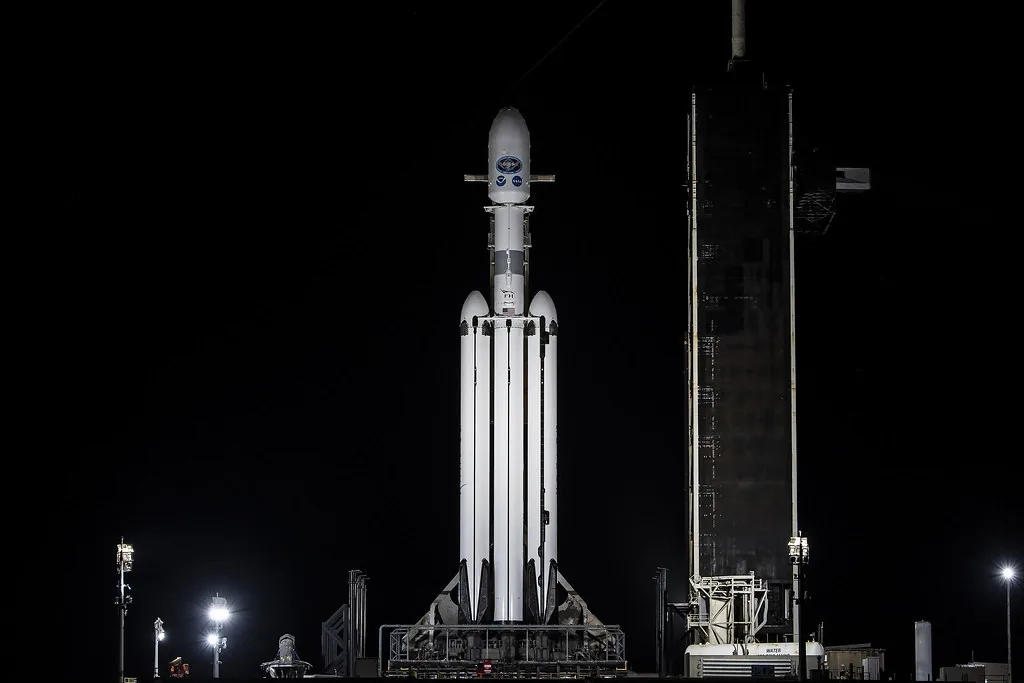
- The Rocket and the Site: Falcon Heavy From Pad 39A
- Why the Launch Date Moved Up
- What Happens After Liftoff: L2, Commissioning, First Science
- Named for Nancy Grace Roman — and What It's Actually Built to Find
- FAQ: Roman Space Telescope Launch
Set an alarm for 7:26 AM EDT on August 30, 2026 — a Sunday. That’s when a SpaceX Falcon Heavy is due to lift the Roman Space Telescope off pad 39A at Kennedy Space Center in Florida, and NASA plans to stream the whole thing free, no account required, on NASA+, NASA TV and YouTube.
Most coverage of this launch leads with the “100,000 new worlds” headline. That’s a real number, and we’ll get to it. But it doesn’t tell you when to set an alarm or where to click. This piece does that first.
When and What Time Is the Roman Space Telescope Launch?
The current target is August 30, 2026. Liftoff is scheduled for 7:26 AM Eastern Daylight Time, which converts to 11:26 UTC.
The rocket is a SpaceX Falcon Heavy. It lifts off from Launch Complex 39A at Kennedy Space Center in Florida. NASA’s Launch Services Program, based at Kennedy, runs the launch itself. The mission as a whole is managed out of NASA’s Goddard Space Flight Center in Greenbelt, Maryland.
That’s the plan as of now. It could still shift.
Launch Time by Timezone: EDT, UTC, PT and CEST
If you’re not on the US East Coast, here’s the conversion. NASA states the EDT and UTC times directly. The Pacific and Central European figures below are calculated from the standard offsets in effect for late August 2026 — EDT is UTC-4, PDT is UTC-7, CEST is UTC+2 — not numbers NASA itself has published.
| Timezone | Launch time, Aug. 30, 2026 | Source |
|---|---|---|
| EDT (US East) | 7:26 AM | NASA, confirmed |
| UTC / GMT | 11:26 AM | NASA, confirmed |
| PDT (US West) | 4:26 AM | Calculated |
| CEST (Central Europe) | 1:26 PM | Calculated |
Set two alarms if you’re on the West Coast. 4:26 AM is early.
How to Watch the Roman Telescope Launch Live
NASA is running this as a free public broadcast. No subscription, no login wall. Four places to catch it:
- NASA+, the agency’s own streaming platform — no account needed
- NASA TV, at nasa.gov/live
- NASA’s official YouTube channel
- SpaceX’s YouTube channel
One gap in what NASA has published so far: the exact minute the countdown broadcast itself opens. That detail typically comes out closer to the launch date, and it isn’t in the sources checked for this piece.
For day-of updates before the stream even starts, NASA’s mission accounts are the ones to watch: X at @NASARoman, Facebook at @NASARoman, and Instagram at @NASAGoddard and @NASAUniverse. Those handles turned up in search results rather than on NASA’s own mission page directly, so treat them as likely correct rather than double-confirmed.
The Rocket and the Site: Falcon Heavy From Pad 39A
Pad 39A has a long history — it’s the same complex NASA has used for decades of major launches. For Roman, SpaceX’s Falcon Heavy is the ride. Kennedy Space Center’s Launch Services Program handles the countdown and launch operations. Goddard, in Maryland, owns the mission and the spacecraft.
Same pad. Different payload.
Why the Launch Date Moved Up
Roman’s original target was early September 2026. NASA moved the date up by about one month, to August 30 — though agencies routinely revise dates for weather or technical holds, so treat it as provisional until liftoff.
Joel Montalbano, NASA’s acting associate administrator for space operations, revealed the new date on a presentation slide, describing it as a schedule that had “just recently updated.” Why NASA accelerated the timeline isn’t stated in any of the sources reviewed here. That’s a gap worth naming rather than guessing at.
What Happens After Liftoff: L2, Commissioning, First Science
Roman isn’t headed for Earth orbit in the way a crewed mission would be. Its destination is the Sun-Earth L2 point, roughly 1.5 million km from Earth.
Once it arrives, the telescope goes through about 90 days of commissioning — checking and calibrating its instruments before any science begins.
Then the real work starts. NASA’s expected start date for official science observations is early 2027.
Named for Nancy Grace Roman — and What It’s Actually Built to Find
The telescope is named after Nancy Grace Roman, NASA’s first chief astronomer. She’s often called the “Mother of Hubble.”
Roman’s hardware, in numbers:
- Telescope mass: 8,000 kg, or 10,500 kg fully fueled
- Primary mirror: 2.4 meters across
- Wide Field Instrument focal plane: 18 infrared detectors, 288 megapixels
- Field of view: about 0.28 square degrees — at least 100 times wider than Hubble’s comparable camera
- Data downlink: roughly 1.4 terabytes per day
- Also carries the Coronagraph Instrument, a technology demonstrator that blocks starlight to attempt direct imaging of exoplanets
That wide field of view is the reason for the “100,000 worlds” headline. NASA released a simulation in May 2026, built around what it calls the Galactic Bulge Time-Domain Survey, projecting around 100,000 planet detections.
For comparison, humanity has confirmed roughly 6,000 exoplanets total across the past few decades — though that comparison figure comes from search snippets rather than a source read in full, so hold it loosely.
Inside that 100,000 figure, the microlensing technique alone is projected to turn up somewhere between 1,000 and 2,500 planets, out of roughly 100 million target stars surveyed. Separately, NASA also expects Roman to find “thousands of exoplanets” through other methods, plus direct images of exoplanets and the disks of gas and dust that form them.
One search result put the range for transiting planets as low as 60,000 and as high as 200,000. That specific range wasn’t confirmed against a readable source, so treat it as unverified.
Here’s the part the “100,000 worlds” headlines skip: that number is a simulation projection tied to a survey that hasn’t happened yet. It says nothing about the launch date, the launch time, or how to watch it. That’s the actual gap in most of this coverage — and the reason this article leads with the countdown clock instead.
Exoplanets aren’t the whole mission. Roman’s other targets:
- Dark energy research, listed as one of the mission’s core objectives
- More than 100 million galaxies to be observed
- Roughly 80,000 Type Ia supernovae expected to be detected
- An estimated 1,000 undiscovered Jupiter-like moons and 200 undiscovered Saturn-like moons in our own solar system
- Survey speed 100 to 1,500 times faster than Hubble across comparable sky area
The primary mission is planned to run 5 years. NASA expects the onboard fuel supply to last 5 years or longer.
FAQ: Roman Space Telescope Launch
What time does the Roman Space Telescope launch on August 30, 2026? 7:26 AM EDT, or 11:26 UTC, from Kennedy Space Center pad 39A, on a SpaceX Falcon Heavy.
Where can I watch it live for free? NASA+, NASA TV at nasa.gov/live, NASA’s YouTube channel, and SpaceX’s YouTube channel. The exact start time of the countdown broadcast itself hasn’t been published yet.
Is there a backup launch date if August 30 slips? Not one that’s publicly listed. Nothing in the sources checked names a specific backup date — only that August 30 is the current target.
One more gap: no source reviewed here puts a dollar figure on what the mission costs. Treat August 30 as the current target, not a lock, and check NASA’s own launch page again as the date nears.
Sources
- Roman Launch Countdown — NASA Science — https://science.nasa.gov/mission/roman-space-telescope/roman-launch-countdown/
- Nancy Grace Roman Space Telescope (mission page) — NASA Science — https://science.nasa.gov/mission/roman-space-telescope/
- The Nancy Grace Roman Space Telescope launch: What to expect — The Planetary Society — https://www.planetary.org/articles/the-nancy-grace-roman-space-telescope-launch-what-to-expect
- Nancy Grace Roman Space Telescope — Launch Schedule — NASA.gov — https://www.nasa.gov/event/nancy-grace-roman-space-telescope/
- NASA Sets Launch Date for Roman Space Telescope — SpacePolicyOnline.com — https://spacepolicyonline.com/news/nasa-sets-launch-date-for-roman-space-telescope/
- NASA is set to launch a telescope on August 30 that could detect around 100,000 new worlds — SpaceDaily — https://spacedaily.com/t-roman-august-30-100000-worlds-100-times-hubble-field/
</content>
Image credits
- GOES-U Vertical on Launch Pad by NOAASatellites, licensed under PDM (via Openverse)
- Webb’s Spacecraft Element Undergoing Acoustic Testing by James Webb Space Telescope, licensed under BY (via Openverse)
- Swiss Confederation Tour at NASA Goddard by NASA Goddard Photo and Video, licensed under BY (via Openverse)