Quick answer
Glacier mice are real, living moss-and-sediment balls found on a small number of glacier surfaces. Iceland has a long scientific record of them, but the evidence does not support a “three guaranteed places to see them” itinerary. Research tells us where scientists have sampled them; it does not tell us where a visitor will find one on a particular day. The most useful way to plan is to separate a safe glacier-viewing stop from a guided glacier activity, and treat a glacier-mouse sighting as a bonus—not the promised product.
Why “three places to see them” is the wrong question
The number depends on what is being counted. In a 1951 letter, Icelandic glaciologist Jón Eyþórsson described moss-covered stones at Hrútárjökull, nearby Kvíárjökull and Breiðamerkurjökull. He recorded a July observation at Hrútárjökull and a later visit to Breiðamerkurjökull; this was a short correspondence, not a modern, systematic survey of visitor access. The 2008 Falljökull study documented broad patches of globular moss growth there. A 2024 chemistry study sampled glacier mice specifically at Falljökull. Then a 2025 survey sampled cryoconite across five Icelandic glaciers and reported glacier mice at Fjallsjökull, Falljökull and Kvíárjökull.
Those papers answer different questions and use different sampling designs. They do not establish a complete national inventory, current abundance, a marked viewing point, or a repeatable visitor route. Counting named research locations as “tour stops” turns scientific records into a travel promise the studies never made.
| What the source establishes | What it does not establish |
|---|---|
| Eyþórsson’s 1951 correspondence records observations at three named glaciers. | That all three have a current, safe, public viewing point. |
| Falljökull has been a field site for moss, movement and invertebrate studies. | That a commercial tour visits a mouse cluster or that a visitor will see one. |
| The 2025 study found glacier mice at three of the five glaciers it sampled. | That the five glaciers are the only places they exist, or that the mice remain at the sample locations today. |
What the Iceland research actually found
Two Falljökull papers add more than a cute name. Porter and colleagues’ 2008 field study described moss cushions growing over debris on the glacier. The moss insulates the ice directly below, leaving a small pedestal as nearby ice melts; the cushions can then slide or topple downslope. That is a plausible physical explanation for how these balls change position, but it does not by itself explain coordinated “herd” travel.
Coulson and Midgley’s 2012 study examined ten glacier mice near the Falljökull terminus. Five carried small motion-and-temperature loggers for a short observation window; the accelerometer record covered 285 hours. It recorded sticking, gradual creep and discrete rolls. Most roll events occurred after roughly 12–40 hours, with rotations commonly around 30–60 degrees. This is evidence that individual balls can rotate and roll on that particular glacier—not a measurement of how far Icelandic glacier mice travel per day.
The same paper is often summarized with striking animal counts, so the sampling details matter. The researchers found two springtail species; the dominant species ranged from zero to 73 individuals per mouse in the dry-extracted samples. Tardigrades were counted in two wet-extracted mice, at about 200 in each; one of those mice contained more than 1,000 nematodes. Those are small, method-specific samples, not a universal “average mouse” or proof every ball contains the same community. The study supports the more careful point: a moss cushion can form a moist, relatively buffered habitat on otherwise exposed ice.
There is also a useful correction to a widely repeated temperature detail. In the 2012 Falljökull measurements, the highest recorded temperature inside a mouse was 12.4°C. The 14.7°C maximum belonged to the surrounding air, not to a moss ball. The difference matters because a temperature number without its measurement location can make the microhabitat seem warmer than the data show.
Where the famous 2.5 cm a day comes from
The headline-grabbing movement rate is from Root Glacier in Alaska, not Iceland. Hotaling, Bartholomaus and Gilbert tagged 30 moss balls there in 2009 and followed the site over several summers. Their 2020 study reported average movement of about 2.5 cm per day and multi-year persistence for mature balls. The group’s direction shifted during the season, but movement did not line up neatly with the local slope, dominant wind or incoming sunlight. The authors therefore left the cause of the coordinated direction change unresolved.
That is an important research result precisely because it is incomplete: the “herd” behavior is an observation, while its mechanism remains a question. It would be inaccurate to attach the Alaska speed to Falljökull or to promise that a visitor could watch a moss ball move. Individual rotation recorded by Icelandic sensors and average translation measured in Alaska are related topics, not interchangeable measurements.
What newer research adds—and what it does not mean
A 2024 study compared cryoconite from Virkisjökull, Skaftafellsjökull and Falljökull, and analyzed glacier mice from Falljökull for elements and fallout radionuclides. It reported higher concentrations in the glacier material than in nearby proglacial sediment, while noting that key radionuclide activity in Icelandic cryoconite was low compared with many Northern Hemisphere glaciers. The authors concluded that deposits released and diluted during melt and retreat were unlikely to be an environmental concern after transport into nearby proglacial areas.
A 2025 follow-up expanded sampling to five glaciers: Fjallsjökull, Falljökull, Kvíárjökull, Skaftafellsjökull and Sólheimajökull. Glacier mice were found at the first three. The paper reported elevated plutonium in some samples compared with earlier Icelandic measurements, but said its origin was unclear; it also described the likely ecosystem effect as limited. These are environmental-monitoring studies, not tests of tourist exposure or medical risk. They do not justify alarm about standing near a glacier, and they do not make it sensible to touch, collect or disturb a fragile moss ball.
The newer work changes the story from “a curiosity that moves” to “a small habitat and sediment collector worth monitoring.” That is a more valuable reason to care: glacier surfaces can retain biological communities and traces of material transported through the environment, even as the ice retreats.
A practical visit: choose the experience, not a sighting claim
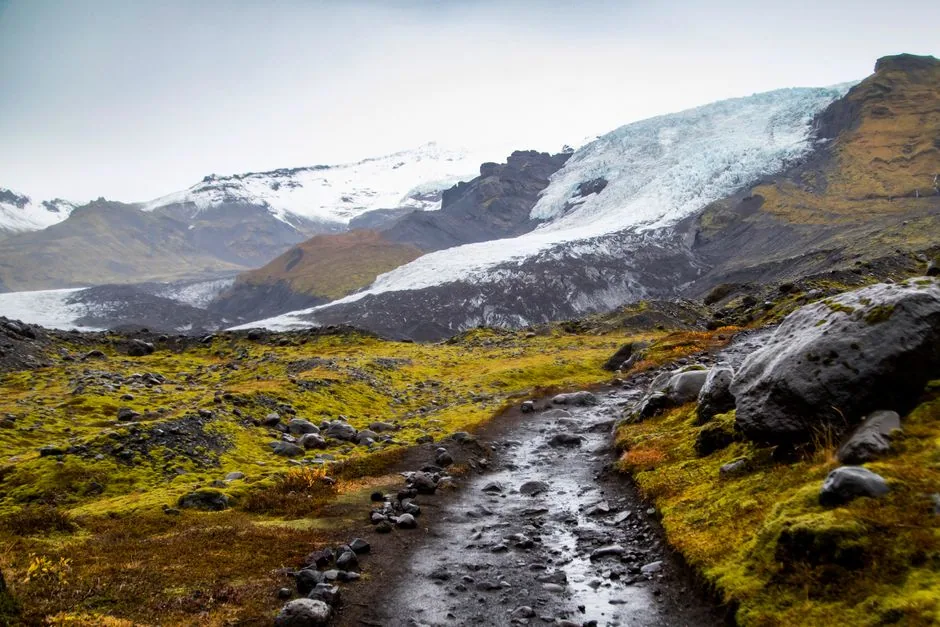
If you mainly want a glacier view, Vatnajökull National Park’s official Jökulslóð S1 route in Skaftafell is a 4.1 km easy loop listed at about 1–1.5 hours. The park says it ends close to Skaftafellsjökull and asks visitors who approach the glacier to follow the warning sign at the trail end. This is a marked viewpoint and a good way to understand a retreating glacier landscape. The park page does not advertise it as a glacier-mouse viewing route, and Skaftafellsjökull should not be confused with the separate Falljökull research site.
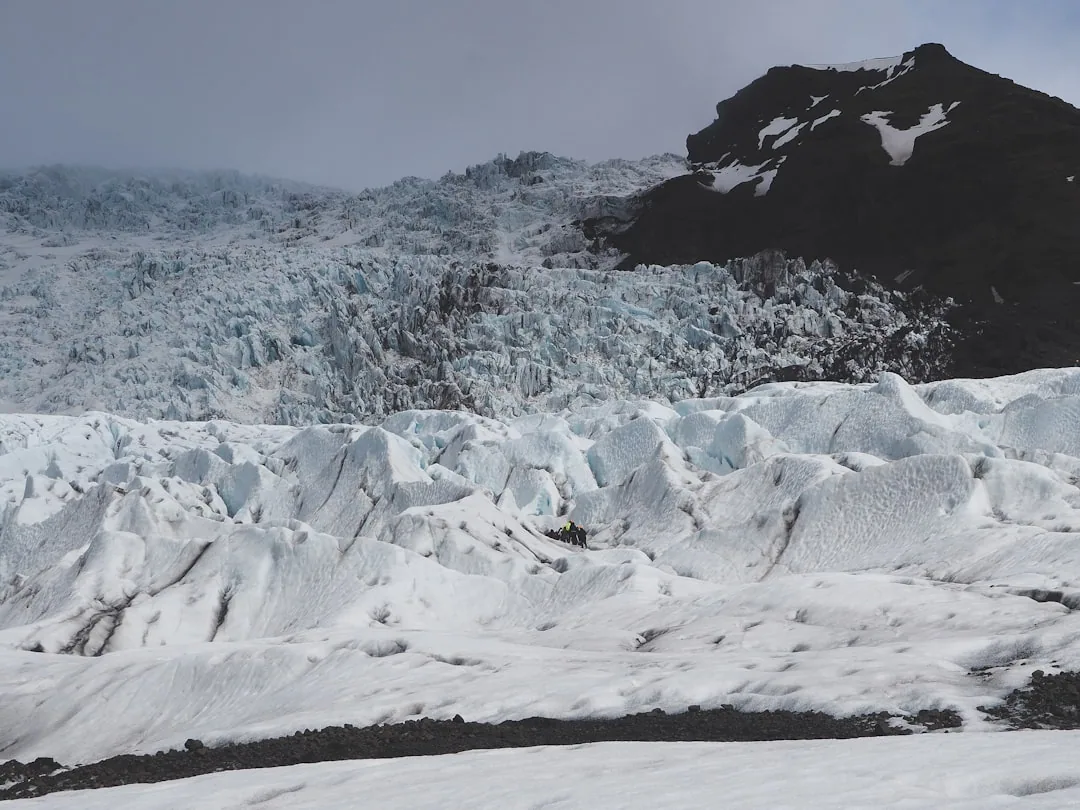
If you want to walk on glacier ice, treat that as a separate activity. Check the route, meeting point, equipment and current operating conditions directly with a qualified local guide. Ask whether a tour actually goes onto Falljökull if that location matters to you. Even then, a glacier hike is not a glacier-mouse tour unless the operator explicitly says so—and the research offers no basis for a sighting guarantee. Do not leave marked paths or a guide’s route to search for moss balls.
- For a scenic, low-commitment stop: use the park’s current marked Skaftafell route and check closures and weather before setting out.
- For time on the ice: compare guided routes and safety details, rather than booking on the assumption that wildlife will be present.
- For the science: remember which result belongs where—rotation and habitat work at Falljökull; the 2.5 cm/day tracking result at Root Glacier, Alaska.
Sources and limits
- Jón Eyþórsson, “Jökla-mýs,” Journal of Glaciology 1(9), 1951, p. 503. Original correspondence.
- P. R. Porter et al., “Sediment–moss interactions on a temperate glacier: Falljökull, Iceland,” Annals of Glaciology 48 (2008), 25–31. DOI and publisher abstract.
- S. J. Coulson & N. G. Midgley, “The role of glacier mice in the invertebrate colonisation of glacial surfaces,” Polar Biology 35 (2012), 1651–1658. DOI · Accepted manuscript.
- S. Hotaling, T. C. Bartholomaus & S. L. Gilbert, “Rolling stones gather moss: movement and longevity of moss balls on an Alaskan glacier,” Polar Biology 43 (2020). DOI · Full paper (NPS repository).
- E. Smith et al., “Radiological and elemental composition of cryoconite and glacier mice from Vatnajökull, Iceland,” Science of the Total Environment 951 (2024), 175828. DOI · PubMed abstract.
- K. Kołtonik et al., “Exceptional plutonium accumulation in glacier mice and cryoconite in Icelandic glaciers,” Science of the Total Environment 999 (2025), 180370. DOI · PubMed record and abstract.
- Vatnajökull National Park: Jökulslóð S1 visitor trail.
Scope note: the research papers are field studies at specific glaciers with different methods and sample sizes. They are not a live wildlife map or a visitor-access inventory. Park route information should be checked again before travel because access, closures and weather can change.
Image credits
- Stephen Leonardi / Pexels (marked path photograph).
- Antonio Morillas / Unsplash (glacier landscape photograph used as the featured image).