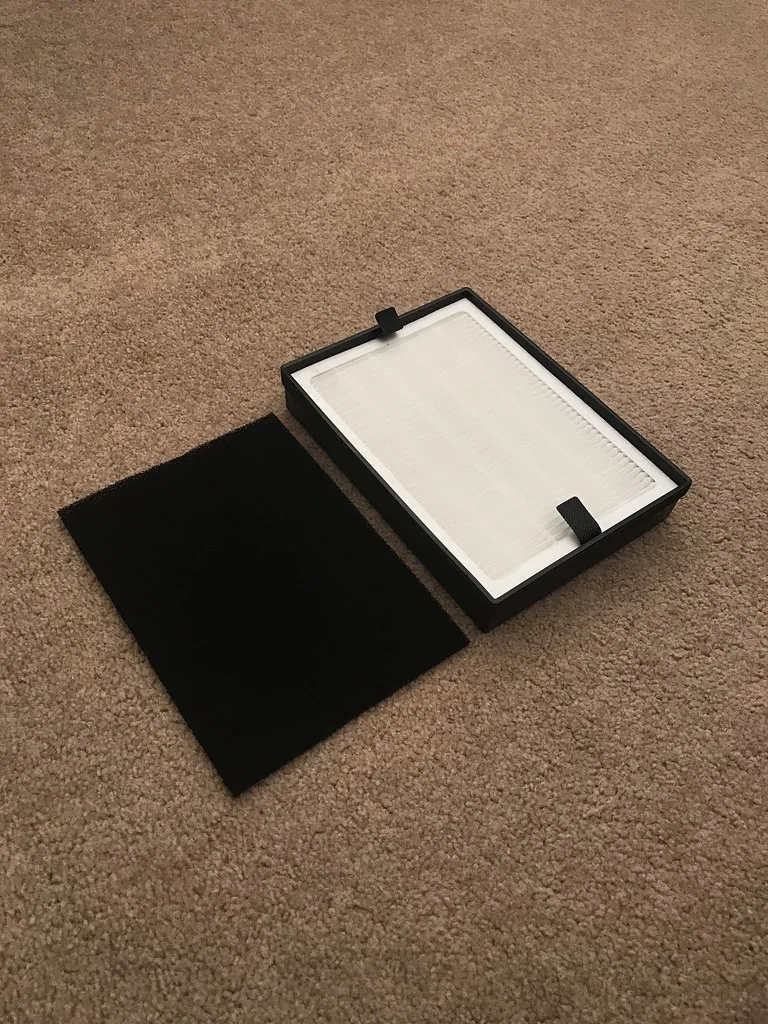
HEPA filters, ionizers, and charcoal products are often sold as if they solve the same air-quality problem. They do not. A particle filter is designed to capture particles; an ionizer changes how particles behave in the air; and a sorbent such as activated carbon can capture some gases when there is enough suitable material and airflow through it.
This comparison is based on guidance from the U.S. Environmental Protection Agency (EPA), California Air Resources Board (CARB), and the Association of Home Appliance Manufacturers (AHAM). We did not laboratory-test these technologies or compare named products.
Choose by the pollutant you want to reduce
| What you want to address | What to look for | What the label cannot tell you by itself |
|---|---|---|
| Smoke, pollen, dust, or airborne particles | A mechanical particle filter and a clean-air delivery rate (CADR) appropriate for the room | A filter-efficiency percentage does not tell you how much clean air the complete device delivers into your room. |
| Some odors or gaseous pollutants | A gas-phase sorbent such as activated carbon, with the amount and replacement instructions disclosed | “Carbon” on the box alone does not establish capacity, which gases are captured, or how long the media lasts. |
| Both particles and some gases | A combination device with a particle filter plus a substantial sorbent stage | Neither stage removes every indoor pollutant. A purifier also does not fix the source of pollution. |
| Ionizer or ozone-generating feature | Understand its particle-collection design and check applicable safety certification | Low ozone certification is not proof of strong particle cleaning, gas removal, or health benefit. |
HEPA: a particle filter, not an all-purpose cleaner
HEPA describes high-efficiency particle filtration. The familiar U.S. benchmark is capture of at least 99.97% of particles at 0.3 micrometers under the specified filter test. That figure describes filter media under a test condition; it is not a promise that a room will become 99.97% cleaner. Airflow, seals, fan speed, room size, placement, and how long the device runs all affect room-level results.
For a portable room cleaner, compare the smoke CADR with the room size when smoke or fine particles are the concern. AHAM’s consumer guidance uses a smoke CADR at least two-thirds of the room’s floor area as a practical starting point for a standard-height room. A high ceiling, open plan, frequent door opening, or strong pollution source can call for more capacity. CADR is a particle-cleaning measure; it should not be treated as a rating for removing gases or odors.
HEPA media does not, by itself, remove gaseous pollutants such as many VOCs or odors. It also cannot solve a continuing source such as smoking, a leak, or mold growth. EPA guidance recommends source control and ventilation where appropriate, with air cleaning as a supplement.
Ionizers: check what happens to the charged particles
Ionizers release charged ions that attach to airborne particles. Depending on the device, particles may collect on an internal plate, settle onto nearby surfaces, or be removed through another stage. Designs differ, so “ionizer” alone does not tell you how much particle removal to expect. EPA notes that some ion-generating devices can be relatively ineffective for larger particles, do not remove gases or odors, and may produce ozone as a by-product. Deposited dust can also be disturbed again during cleaning or normal activity.
Do not confuse an ozone-emission limit with proof that a device cleans well. CARB certification for indoor air-cleaning devices addresses an ozone-emission ceiling and electrical safety requirements; it is not a general endorsement or a comparative particle-performance rating. Avoid devices marketed to intentionally generate ozone for occupied rooms. EPA advises that ozone concentrations below public-health standards generally do not effectively remove many indoor contaminants, while ozone itself can harm the respiratory system.
Charcoal and activated carbon: performance depends on the media
Activated carbon is a porous sorbent used to capture some gases and odors on its surface. Its performance depends on the pollutant, carbon type, quantity, airflow, humidity, and time in service. EPA’s home air-cleaner guide cautions that a small amount of carbon may have limited capacity and that no residential gas-phase filter removes every gaseous pollutant.
Bamboo is one possible source material for charcoal, but “bamboo charcoal” is not automatically equivalent to a tested activated-carbon filter. A passive charcoal sachet has no fan forcing room air through a measured bed of sorbent, so it should not be treated as equivalent to a properly sized room air cleaner. Claims that one charcoal source is universally superior need product-specific, independently verifiable testing.
For a gas or odor concern, look for the sorbent’s quantity, the pollutants the maker actually tested, the test conditions, and a replacement schedule. If those details are missing, the label is not enough to predict useful room-level removal. For a continuing odor source, remove or reduce the source first.
A practical buying check
- Name the problem. Smoke and pollen are particles; cooking smell and some VOCs are gases. One rating does not cover both.
- Size the particle cleaner. Compare smoke CADR with the actual room area, and account for ceiling height and open connections to other rooms.
- Read the whole-device details. Check filter replacement cost and availability, fan settings, noise at the setting you will use, and whether air can bypass the filter.
- For gases, inspect the sorbent stage. Find the type and amount of media, the specific gases tested, and replacement guidance. A thin carbon-coated pre-filter may have limited capacity.
- Review ionizer and ozone claims separately. Check certification in the jurisdiction where you live, but do not treat certification as a cleaning-performance score.
- Use source control first. Ventilate when outdoor conditions allow, fix moisture and combustion sources, and follow public-health advice during smoke events.
What we can conclude—and what we cannot
For airborne particles, a properly sized mechanical room cleaner with a published CADR is the clearest comparison path. For some gases and odors, a separate sorbent stage may help, but the material and quantity matter. Ionizer features vary, and an ozone-safety listing does not establish that a unit is effective for a particular room or pollutant.
There is no sound basis here for declaring one material or brand the universal winner. We have not measured these products side by side, and room-level outcomes depend on the device, pollutant, room, and use. Treat manufacturer claims as product-specific claims and seek the underlying test method before relying on them.
Common questions
Does HEPA remove cooking smells?
HEPA is intended for particles, not gases. A device may also contain a gas-phase sorbent such as activated carbon; check how much media it contains and what the manufacturer tested.
Is a charcoal bag the same as an air purifier?
No. A passive bag has no fan or room-cleaning CADR. It may be useful in a small enclosed space for a limited purpose, but it is not equivalent to a room air cleaner.
Does CARB certification mean an ionizer works well?
No. CARB certification addresses ozone emissions and electrical safety for covered devices. It is not a measure of particle CADR or a guarantee of health benefits.
Can an air purifier replace ventilation or fixing the source?
No. EPA recommends addressing pollution sources and ventilation where appropriate. Air cleaning is a supplement, and it cannot repair a leak, remove mold growth, or stop an ongoing emission by itself.
Sources and further reading
- U.S. EPA: Guide to Air Cleaners in the Home — particle and gas filters, CADR, room sizing, source control, and ventilation.
- U.S. EPA: Ozone Generators Sold as Air Cleaners — ozone exposure and limits of ozone-based cleaning.
- U.S. EPA: Ionizers and Other Ozone-Generating Air Cleaners — how ionizers work and their limitations.
- California Air Resources Board: Air Cleaning Devices for the Home — what CARB certification covers.
- AHAM Verifide Directory — independently verified CADR listings for participating room air cleaners.
- AHAM: Tips for Choosing a Portable Room Air Cleaner — practical CADR and room-area guidance.
Image credit
- Air Purifier HEPA Filter Pre-filter by Home Air Quality Guides, licensed under CC BY-SA 2.0 (via Openverse).